
Lightning Fast Turnaround!
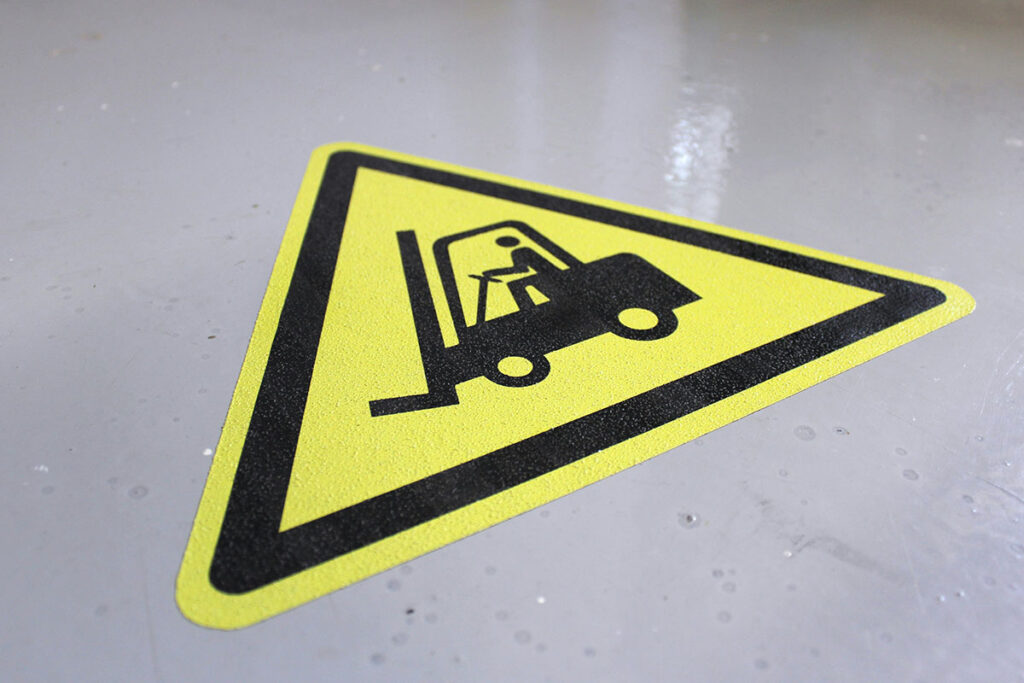
Standard stickers work fine on a laptop or a notebook. But consider the warning label on a piece of heavy machinery, the branding on an outdoor rental kayak, or the service sticker inside a vehicle’s engine bay. These surfaces see grease, oil, chemicals, constant UV exposure, and regular pressure washing. San Antonio commercial labels that can’t handle that isn’t just an aesthetic failure, it’s a functional one.
In those conditions, paper stickers fail within days, and basic vinyl doesn’t last much longer. The ink smears, the adhesive lifts, and the substrate breaks down, taking the warning text or branding with it. What these applications need isn’t just a sticker; it’s a label engineered specifically to hold up in that environment.
An industrial-grade sticker’s durability comes from three components working together: the material, the adhesive, and the lamination. Get any one of them wrong and the whole label fails.
The base material determines everything that follows.
Paper absorbs moisture, oil, and grease almost immediately. What was a legible label becomes a pulpy, unreadable mess within days.
Standard vinyl is a reasonable starting point, but for genuinely harsh environments, polyester-based film is usually the better option. Polyester is non-porous, so chemicals and solvents can’t penetrate it. It also holds its dimensions at temperature extremes where some vinyls stretch or shrink, which matters when a label needs to stay readable after cycling between a cold storage unit and direct sunlight. For engine bays, chemical tanks, or outdoor equipment, that dimensional stability is what keeps a label legible long-term.
The adhesive keeps the label on the surface. Standard adhesives are formulated for clean, smooth substrates, they bond poorly to oily or textured surfaces, and that bond degrades further when the surface flexes or heats up.
Fine for a glass jar or a smooth painted wall, but it won’t hold on a greasy engine block or a low-surface-energy plastic like polyethylene, the material used in kayaks, coolers, and most outdoor equipment.
High-tack adhesives are formulated for a stronger initial grab, useful when the label needs to stick immediately and stay put. Aggressive permanent adhesives go further: they’re designed to bond to difficult surfaces, including slightly oily or textured materials, and the bond actually strengthens over the first 24 to 72 hours as the adhesive cures into micro-irregularities in the surface. After that curing period, removing the label typically destroys it.
The laminate sits on top of the printed ink and does two jobs: it keeps abrasives and tool edges from scratching through to the print, and it blocks the solvents and chemicals that would otherwise dissolve it.
Skip the laminate and the ink is exposed. A single pass with a solvent rag, a scrape from a tool edge, or a direct hit from a pressure washer nozzle can strip the print down to bare material, even if the underlying ink is rated for outdoor use.
Standard vinyl laminate works for indoor labels. Industrial environments require polyester or polycarbonate. These are harder materials, less prone to scratching through, more resistant to the MEK and acetone-based cleaners common in manufacturing and fleet maintenance, and rigid enough that a pressure washer jet can’t curl the edge up. The ink underneath stays readable.
Stack polyester base, high-tack adhesive, and polycarbonate laminate together and you get a label that stays put, stays legible, and doesn’t need replacing every season.
Pressure washing is where most commercial labels fail. Fleet trucks running through depot wash bays see water jets at 1,500-3,000 PSI. Heavy equipment gets hosed down before maintenance checks. Stickers that hold up fine after a year in the field can be gone after one wash cycle if they were never rated for it.
Pressure washer resistance comes down to two things: material profile and edge bond. A thick sticker gives the jet something to catch, the water hits the raised edge and works its way under. Thin vinyl with an aggressive adhesive sits flat against the surface, leaving no gap to exploit. The adhesive does most of the work; the thin profile keeps the water from finding a starting point.
Rounded corners outlast square ones in wash-down environments. A 90-degree corner concentrates the jet’s force at a single point; a rounded corner deflects it. Most label fabricators can round corners at no added cost, and in high-pressure cleaning environments it’s worth specifying when you order.
No adhesive bonds reliably over grease or oil, the contamination sits between the adhesive and the substrate and prevents real contact. Clean the surface with a degreaser or isopropyl alcohol, let it dry completely, then apply. After the adhesive cures, typically 24 hours, it handles oil and grease contact without releasing.
Yes. Industrial-grade vinyl with a UV-resistant laminate meets the durability requirements for OSHA and ANSI safety label standards (ANSI Z535 specifies legibility for the life of the equipment in outdoor use). If you need to confirm your specific application, ANSI Z535 is the reference document for safety label specifications in the U.S.
Look for labels sold as “permanent outdoor vinyl” with a “high-tack” or “aggressive” adhesive rating. When applying, eliminate air bubbles, trapped air expands under the heat of a commercial washer and can burst the surface or lift the edge. A hard squeegee or application card works better than fingertips for this step.
Most industrial vinyl stickers with a protective laminate handle routine fuel splashes without degrading. The limitation is sustained contact, vinyl isn’t rated for submersion in fuel. On equipment where drips are a daily occurrence, a thick gloss laminate is the right call. It resists the chemical softening that causes vinyl to bubble or lift at the edges over time.
With UV-stable inks and a UV-rated laminate, these stickers are rated for three to five years of fade resistance in direct sun, including high-UV environments like Texas or the Southwest. No laminate lasts indefinitely under constant UV exposure, but the rated combination holds color well past what standard indoor-grade labels can manage.
For demanding applications, the combination that holds up best is a polyester base with high-tack permanent adhesive, UV-resistant inks, and a thick polycarbonate or polyester laminate on top. Polyester outperforms standard vinyl for chemical resistance, abrasion, and heat. The laminate then protects the ink layer from the wear that would otherwise reach it first.
Service and inspection labels often need field notation. We handle this with a writeable matte laminate, a surface engineered to accept ballpoint pen or permanent marker without smearing or rubbing off under handling. Standard gloss laminates repel ink, so the material choice matters here.
Testing on your actual surface is the only reliable way to know. Powder-coated metals, low-energy plastics like polyethylene, and textured rubbers all behave differently under adhesive stress. We can send sample materials before you commit to a full production run, that one step catches adhesion problems before they become a costly issue.
San Antonio laminated stickers on industrial equipment isn’t a marketing element, it’s documentation. A safety warning that fades becomes a missing safety warning. A service record that smudges is an unreadable service record. A compliance label that degrades may simply fail inspection. The cost difference between a standard label and a properly engineered one is small; the liability gap if it fails is not. If a label ships on your product, it should meet the same standard as everything else on it.
If your equipment, facility, or product needs a label that holds up under real conditions, heat, chemicals, UV exposure, pressure washing, talk to us. We spec materials based on what the label will actually face, not a one-size catalog answer. Custom orders, sample testing, and short runs are all available for our industrial stickers in San Antonio.
|
Uploaded
Failed
|
 |