Lightning Fast Turnaround!
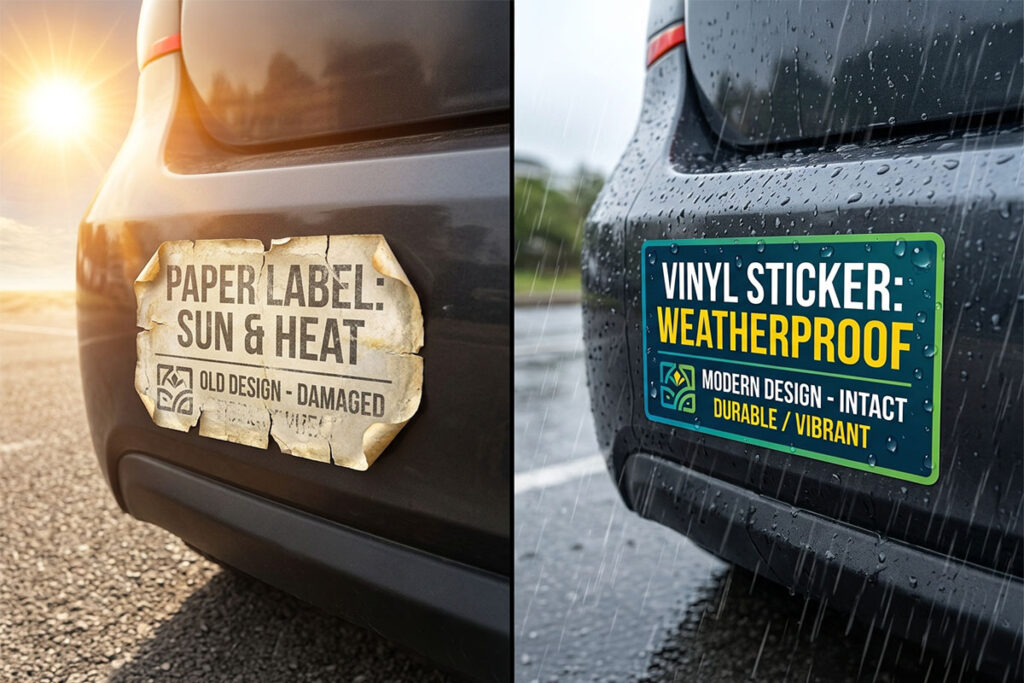
The sun is hard on labels. Long summers bring triple-digit temperatures, relentless sun, and sudden spikes in relative humidity, especially when products move between air-conditioned interiors and hot loading docks. For local businesses, packaging for these conditions is not just a design issue; it’s a materials and adhesive problem.
Whether you sell craft beverages in Austin, artisanal hot sauces, body care items, or outdoor equipment, your label is often the first thing a consumer sees. If it curls at the edges, fades in direct sunlight, or bleeds when moisture hits it, the product looks poorly made and your brand image takes the hit.
Many business owners use “waterproof” and “weatherproof” as if they mean the same thing. They do not. In label production, the facestock, adhesive, ink, and laminate all matter, and the wrong material choice can leave you with peeling edges, faded print, or total adhesive failure. Knowing the difference helps your product stay clean from the warehouse shelf to your customer’s hands.
To choose the right label material, start with the conditions your packaging has to survive. Outdoor stickers, retail packaging, and bumper stickers usually face the same three stressors: UV exposure, humidity, and thermal cycling.
Depending on the area, you could get up to 200 sunny days a year on average. That much direct ultraviolet light breaks down standard ink pigments fast. Without UV-resistant inks, a laminate, or a tougher film stock, unprotected paper labels and low-grade inks can lose their vibrancy within just a few weeks of outdoor display.
Humidity creates a different kind of failure. Bring refrigerated products like craft beer cans or cold-pressed juices into warm air and heavy condensation forms almost immediately. Standard paper materials absorb that moisture, then bubble, wrinkle, or tear apart. For cold, condensation-prone products, film facestocks such as white BOPP or clear BOPP are often a better fit than paper because they resist water at the surface instead of soaking it in.
Surface temperatures on outdoor equipment, food trucks, and vehicle bumpers can easily top 140 degrees Fahrenheit in July and August, especially when dark surfaces sit in direct sun. Heat makes label materials and the underlying container surfaces expand at different rates. If the adhesive is not high-tack and heat-stable, the label starts to slip, flag at the edges, or peel off entirely.
Waterproof and weatherproof both suggest protection against moisture, but they point to different levels of environmental defense. Choosing the proper substrate means matching the material’s structural properties to the specific environment your product will face, whether that is cooler condensation, routine splash exposure, or full outdoor heat and humidity.
| Feature / Property | Waterproof Substrates | Weatherproof Substrates |
| Primary Base Material | Synthetic polymers (BOPP, Polypropylene, Vinyl) | Heavy-duty Cast Vinyl or Polypropylene with UV Overlaminates |
| Liquid Resistance | Complete resistance to direct water immersion & oils | Resistant to rain, submersion, chemicals, & solvents |
| UV & Sun Protection | Moderate (Standard inks fade without added UV protection) | Maximum protection via UV-inhibiting clear laminates |
| Temperature Tolerance | Suitable for indoors, refrigeration, & cold condensation | Engineered for extreme outdoor heat (140°F+) & cold cycles |
| Ideal Applications | Bath products, refrigerated food, beverage cans, squeeze bottles | Bumper stickers, outdoor gear, industrial machinery, vehicle decals |
A waterproof label is made from materials that will not absorb water or break down when wet. Common waterproof substrates include biaxially-oriented polypropylene (BOPP) and standard synthetic film, both of which are widely used when a paper face stock would soften, wrinkle, or fail.
Waterproof materials are the right fit for products exposed to moisture, oils, or liquid spills. Cold beverages, shampoos, lotions, and hot sauces all need waterproof properties to keep moisture from saturating the face sheet, whether the package sits in a refrigerator, on a shower shelf, or on a prep line.
Still, a label can be completely waterproof and still fail outdoors. Standard waterproof films without specialized UV coatings can yellow, crack, or fade when left under direct sunlight for extended periods, so water resistance alone does not guarantee outdoor durability.
Weatherproof labels are a higher tier of durability. A weatherproof substrate combines a waterproof synthetic base, such as thick vinyl, with specialized, weather-resistant adhesives and protective UV laminates so the full label construction can hold up outside, not just the face stock.
These engineered materials are built to resist moisture, direct rain, continuous sunlight, heat, abrasion, and mild chemical exposure. Weatherproof vinyl is the industry standard for bumper stickers, outdoor equipment branding, vehicle wraps, and agricultural packaging because those applications have to handle more than water.
A basic waterproof label can handle cold water condensation inside a refrigerator. A weatherproof label is built for outdoor use, like staying attached to a car bumper on I-35 during August while dealing with sun, heat, and road grit.
To build a label that survives harsh climates, every layer of the label construction has to perform reliably under thermal stress, from the laminate on top to the adhesive underneath.
Paper face stocks should generally be avoided for outdoor applications or high-moisture environments because they are usually the first layer to fail. High-grade outdoor vinyl or BOPP plastic materials provide the flexibility required to expand and contract with temperature swings without cracking, which is why they hold up better on coolers, containers, and outdoor equipment.
Adhesive failure is the leading cause of label breakdown in hot climates. Cheap rubber-based adhesives soften when a bottle, jar, or carton sits in heavy heat, so the edges get sticky and start lifting. High-performance acrylic adhesives hold much better on glass, metal, and hard plastics such as PET and HDPE because they keep their bond even when the surface gets hot.
The ink on your label needs its own protection against sunlight and scratching. A clear gloss or matte UV laminate puts a tough topcoat over the printed surface, which helps keep the color looking clean and readable. That laminate shields the print layer from solar fading, road grit, surface scratches, and moisture penetration.
The right substrate depends less on the design and more on where the product actually lives: on a dry retail shelf, in a cooler, or in the back of a hot delivery truck. A few simple operational questions will usually point you to the right choice:
Testing labels in real conditions is worth the time. Put sample labels on your actual packaging, then run them through the same abuse they will see after launch: a cold cooler, a humid loading dock, heat, moisture, rubbing, stacking, and everyday handling. That kind of trial catches edge lift and print wear before you commit to a bulk production order.
Waterproof labels are made to resist water absorption and moisture damage, which makes them a good fit for liquid products, refrigerated items, and anything that sweats with condensation. Weatherproof labels go further: they pair waterproof facestocks such as BOPP or vinyl with UV laminates and heat-stable adhesives so they can handle outdoor sun, wind, rain, and heat exposure.
Standard rubber-based adhesives can soften and lose tack in extreme heat, especially on containers that sit in a storefront window or the back of a delivery van. Professional weatherproof labels usually use permanent acrylic adhesives instead because they are built to handle high surface temperatures without breaking down or sliding off containers.
Yes. Paper labels absorb moisture, tear easily, and break down quickly under sunlight. Vinyl is a flexible plastic substrate, which is why it performs better outdoors: it resists water, sun exposure, and temperature swings that would shorten the life of a paper label.
UV protection usually comes from a specialized clear lamination applied over the printed artwork, not from the ink alone. That layer blocks ultraviolet rays before they can break down the ink pigments, which helps preserve color vibrancy over long periods outdoors.
Yes. High-quality weatherproof vinyl stickers and custom decals are usually finished with a durable laminate and a permanent adhesive, so they can stand up to high-pressure water streams, detergent soaps, and severe rainstorms, including the kind of repeated washdown you get in an automatic car wash.
Your packaging does more than hold the product; it tells customers what kind of business you run. When a label fades, peels, or tears after a few days in the heat, humidity, cooler condensation, or direct sun, people notice, and it does not reflect well on the brand. Choosing high-quality waterproof or weatherproof materials for the actual use case, whether that means a film label, durable vinyl, or a laminate built to handle moisture and UV exposure, helps your packaging stay sharp, readable, and intact in tough conditions.
At The Bumper Sticker, we have printed high-durability custom labels, decals, and stickers here in Texas since 2005. That local experience matters because the right combination depends on where the label will live: on a bottle that sweats in a cooler, on packaging stored in a hot warehouse, or on products that spend hours in the sun. Our design experts match premium vinyl materials, weather-resistant adhesives, and protective laminates so your branding stays crisp, readable, and built to last.
Ready to create labels built for real-world wear? Contact our team at The Bumper Sticker to review your artwork, talk through substrate options such as waterproof films or weatherproof vinyl, get practical material recommendations, or request a quick quote for your next order.
|
Uploaded
Failed
|
 |